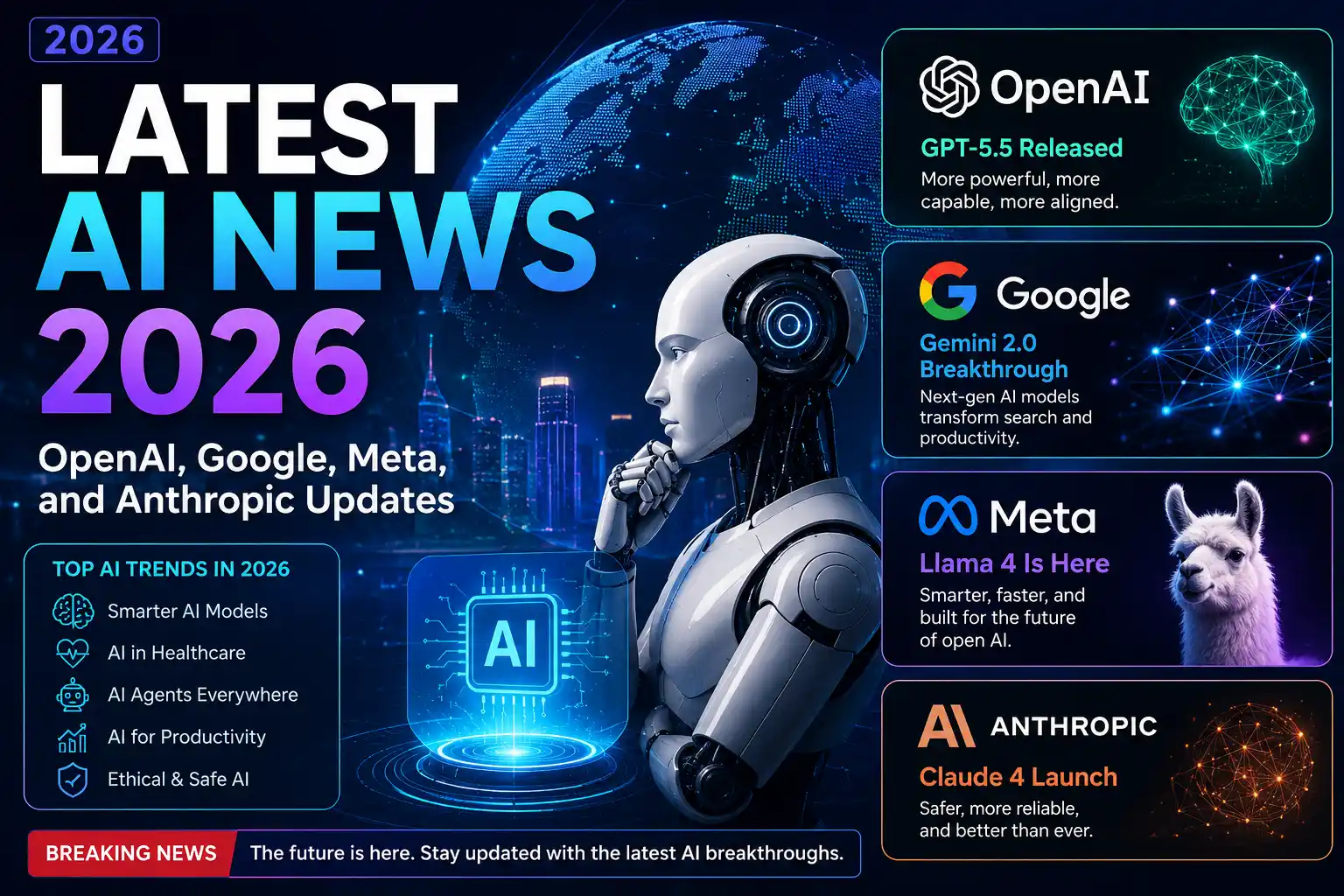
Latest AI News 2026: OpenAI, Google, Meta, and Anthropic Updates
Last reviewed: 2026-07-05
This guide is designed to help beginners and busy decision-makers make sense of the latest AI news in 2026, especially updates related to OpenAI, Google, Meta, and Anthropic. It explains what kinds of announcements matter, how to verify information quickly, and what patterns typically signal real progress. Where specific 2026 announcements are discussed, treat them as areas to watch and verify via official sources. The analysis here draws on public patterns and documentation available through late 2024 and common industry practices.
What 'latest AI news' means in 2026
AI news in 2026 spans far more than a single product launch. For beginners, it helps to group headlines into a few practical buckets. When you see an announcement, ask: which bucket does it fit? That makes it easier to compare vendors and decide whether it matters to you.
1) Core model improvements
- Reasoning and reliability: Better multi-step reasoning, planning, and reduced hallucinations. Look for thorough evaluations or independent replications.
- Multimodality: Single models that handle text, images, audio, code, or video. Watch for input/output combinations and latency.
- Context window: How much a model can read at once. Bigger windows can improve continuity and document understanding, but also affect cost and speed.
- Tool use and agents: Built-in ability to call tools, browse documentation, write code, or interact with apps and workflows.
2) Platform and product changes
- APIs and SDKs: New endpoints, fine-tuning options, function calling, streaming methods, and security features.
- Integration surfaces: Search engines, office suites, messaging tools, developer IDEs, CRM platforms, or on-device features.
- Enterprise controls: Data retention settings, SOC 2/ISO attestations, tenancy, region controls, and audit logs.
3) Safety, policy, and governance
- Safety systems: Improved content filters, model guardrails, provenance and watermarking, red-teaming results, and reporting channels.
- Compliance alignment: References to frameworks such as the EU AI Act, NIST AI RMF, GDPR, HIPAA. Look for concrete documentation and technical controls.
- Data sourcing and rights: Signals around training data transparency, copyright handling, opt-outs, or partnerships with content owners.
4) Performance and economics
- Latency and throughput: Lower response times, higher requests per second, and more predictable performance during spikes.
- Costs and credits: Token pricing, caching, feature-based tiers, and enterprise volume discounts.
- Efficiency: Smaller or distilled models, quantization, on-device inference, and greener compute strategies.
When a company announces something new, mapping it to these buckets turns hype into actionable insight. The rest of this guide applies that lens to the four most-watched AI developers in 2026: OpenAI, Google, Meta, and Anthropic.
OpenAI in 2026: updates to watch
OpenAI has historically focused on pushing general-purpose model capabilities, broad platform access, and developer tools. In 2026, updates to watch likely emphasize better reasoning, richer multimodality, safer automation, and enterprise-grade controls. Treat the following as a verification checklist rather than claims about specific releases; confirm details on OpenAI's official blog, product docs, or status pages.
Models and multimodality
- Unified multimodal models: Text, image, and audio handling from one model or tightly integrated family. Look for examples that blend modalities in a single prompt and consistent safety responses across types.
- Long-context performance: Ability to process large documents and codebases with reliable retrieval. Verify with side-by-side comparisons on your own data, not just synthetic benchmarks.
- Developer ergonomics: Simpler APIs that expose tool use, structured outputs, and consistent function-calling formats to minimize parsing and error handling.
Agents and automation
- Tool orchestration: Built-in planners or orchestrators that can chain steps, call external tools, and maintain memory across tasks.
- Sandboxed execution: Secure code execution, restricted environments, and explicit permission prompts for risky actions.
- Evaluations and guardrails: First-party evaluation tools, red-teaming templates, and safety policies to operationalize agents in production.
Enterprise and platform controls
- Data governance: Clear toggles for data retention, private fine-tuning, and region-specific processing.
- Identity and access: SSO, SCIM, role-based permissions, and detailed audit logs that help compliance teams map model actions to users.
- Reliability: SLAs, region redundancy, and transparent incident postmortems.
Safety and alignment
- Policy transparency: Practical, concrete examples of allowed and disallowed content with in-product enforcement signals.
- Provenance: Watermarking, content labels, or metadata that help platforms and users trace AI-generated outputs.
- Partnerships: Collaborations with academic and civil-society groups for evaluations and red-teaming.
How to verify OpenAI headlines fast: check the official blog and docs for a feature's availability, scan the status page for regional rollouts, and test with sample prompts. For enterprise claims, request documentation on certifications and data handling in writing.
Google in 2026: updates to watch
Google operates across search, ads, cloud, mobile, and research. In 2026, its AI news often intersects with products people already use daily. Expect focus on multimodality, knowledge-grounding, on-device features for Android, and integrations with Workspace. Historically, Google has published research through groups like DeepMind and delivered developer features through Google Cloud.
Search and knowledge experiences
- AI-enhanced results: Generative answers blended with citations. For reliability, check for source links, summarization quality, and ways to toggle or refine the answer.
- Task flows: Embedded planning for tasks like trip planning, shopping comparisons, or how-to guides, with clear handoff into web pages or apps.
- Publisher relations: Signals of deals or frameworks for content usage and attribution.
Workspace and developer ecosystems
- Docs, Sheets, Gmail, and Meet: Writing assistance, data extraction, meeting summaries, and automation. Verify enterprise data isolation and admin controls.
- Cloud AI platform: Model hosting, vector databases, evaluation tools, and pipeline orchestration. Look for unified monitoring across data, model, and prompt layers.
- Responsible AI tooling: Built-in filters, policy compliance templates, and audit features aligned with regulatory regimes.
On-device and Android
- Low-latency models: Speech recognition, translation, and image understanding on device for speed and privacy.
- Hybrid execution: Smart handoffs between device and cloud for heavy tasks, maintaining consistent user permissions and data boundaries.
- Developer APIs: Consistent interfaces for apps to access on-device AI without leaking private data.
Research to product pipeline
- Multimodal families: Continued iteration on large, general models along with specialized smaller ones for efficiency.
- Reasoning and planning: Techniques like tool use, program-of-thought, or search-based methods appearing in end-user products.
- Evaluation openness: Publications and datasets that allow independent verification of claims.
To verify Google AI news, look for matching announcements across the Google blog, product-specific blogs, and Cloud documentation. For enterprise buyers, confirm data residency, Workspace admin controls, and supported compliance reports.
Meta in 2026: updates to watch
Meta has invested heavily in open research and the open-source ecosystem, while also integrating AI into consumer products and AR/VR platforms. In 2026, expect emphasis on accessible models, creator tools, and safety work around generative media. Historically, Meta's Llama family (as of 2024) influenced community adoption and research reproduction.
Open models and developer ecosystem
- Model releases and licenses: Continued updates to open models, with licensing terms that shape commercial use. Carefully read license clauses and usage policies.
- Inference efficiency: Quantized variants and support for common runtimes to make deployment cheaper and faster.
- Community benchmarks: Third-party leaderboards and repos that replicate Meta model claims.
Consumer and creator features
- Generative tools: Image, video, and text assistants inside social apps with controls for style, safety, and attribution.
- Provenance and labeling: Content labels for AI-generated media, watermarking research, and visible user controls.
- AR/VR integration: On-device perception for hands, environment, and context-aware assistance.
Responsible AI in open ecosystems
- Safety baselines: Recommended filters, alignment recipes, and usage guidelines for downstream developers.
- Dataset transparency: Notes on training sources, synthetic data usage, and data filtering pipelines.
- Partnerships and evaluations: Work with external researchers to stress-test releases before wide adoption.
To verify Meta AI updates, check Meta AI research portals, official GitHub organizations, and licensing pages. Watch for reproducibility reports from independent labs for validation.
Anthropic in 2026: updates to watch
Anthropic has consistently emphasized safety, reliability, and helpfulness, including methods like constitutional AI and careful scaling. In 2026, anticipate updates that improve controllability, reduce hallucinations, and offer practical enterprise features that align with regulatory expectations.
Model quality and controllability
- Structured outputs: Stronger JSON adherence and schema validation for production-grade workflows.
- Evidence-grounding: Features that encourage citations or highlight uncertainty when the model is unsure.
- Long-context and retrieval: Robust retrieval-augmented generation with consistent behavior across large documents.
Enterprise features
- Data and privacy: Clear, documented boundaries on training data usage and options for private customization.
- Admin tooling: Role-based controls, logging, and usage analytics that align with risk teams' needs.
- Safety tooling: Evaluations, prompts, and filters that reduce harmful or non-compliant outputs.
Safety research and policy
- Scaling policies: Statements on safe model scaling, release protocols, and red-team participation.
- Auditability: Reports and demonstrations that show not only what the model can do, but also how it behaves under stress.
- Collaboration: Participation in industry and academic efforts on safety standards.
Verify Anthropic headlines by reviewing the official blog and documentation, looking for reproducible examples and clear statements about data use, safety posture, and enterprise controls.
Cross-company AI trends shaping 2026
Across OpenAI, Google, Meta, and Anthropic, several themes define the 2026 landscape. Understanding these trends helps you anticipate real-world impact rather than reacting to every press release.
1) Multimodality everywhere
Models that handle text, images, audio, and video are moving from demos to everyday features. Expect richer input combinations (for example, uploading a screenshot and asking for a configuration fix) and outputs that include images or audio. Quality varies widely by task, so verify with your specific data.
2) Agents and tool use move into production
The leap from a chat assistant to a dependable agent lies in planning, tool orchestration, robust logging, and safe execution. Watch for vendors offering built-in evaluators, permission prompts, rollback paths, and human-in-the-loop checkpoints.
3) On-device and hybrid inference
Performance and privacy pressures are pushing more inference to devices. Expect small, fast models for immediate tasks and cloud handoffs for heavy lifting. A good system hides this complexity while respecting user consent and privacy boundaries.
4) Synthetic data, distillation, and efficiency
To scale responsibly, teams combine synthetic data with careful filtering, distill large models into smaller ones, and use quantization to run on cheaper hardware. These strategies cut costs and environmental impact but require strong evaluations to avoid quality drift.
5) Provenance, watermarking, and content authenticity
As generative media spreads, provenance signals and labels help platforms and users identify AI-generated or edited content. Expect tighter integrations with content supply chains and common metadata standards.
6) Regulation and governance
Global rules are maturing, including risk-based frameworks that require documentation, testing, transparency, and incident response. Buyers should expect vendors to provide compliance mappings, security attestations, and evidence of safe deployment practices.
7) Benchmark realism
Headline leaderboard scores are less persuasive without strong, task-specific evaluations. In 2026, production buyers rely more on domain-relevant tests, cost-latency tradeoffs, and longitudinal performance data.
Benchmarks and evaluations 101 (beginner friendly)
Benchmarks try to measure how well a model performs on a set of tasks. They provide signals, not guarantees. Two models can trade leaderboard wins while behaving very differently on your actual workload. Use benchmarks to guide questions, then run your own evaluations.
Common benchmark categories
- General knowledge and reasoning: Multiple-choice or open-ended questions that test broad understanding.
- Code and math: Programming tasks, test-driven challenges, and multi-step math proofs.
- Multimodal understanding: Interpreting images, charts, audio, or video with associated text.
- Safety and toxicity: Ability to avoid harmful content while remaining useful.
- Instruction following: Adherence to prompts, formats, and schemas.
How to evaluate models for your needs
- Define tasks: Write down real user journeys: inputs, desired outputs, edge cases, and failure impacts.
- Create a small gold set: 50 to 200 examples that represent your data, including tricky corner cases.
- Score with rubrics: For each example, specify what counts as correct, safe, or high-quality.
- Measure costs and latency: Track tokens, response times, and failure rates together with quality scores.
- Test drift: Re-run evaluations monthly to catch changes due to model updates or data shifts.
Red flags to watch
- One-number marketing: Single benchmark scores without breakdowns or caveats.
- Non-reproducible claims: No datasets, methods, or evaluation code offered.
- No cost context: A small quality bump can be outweighed by higher costs or slower responses.
How to track and verify updates in 2026
With daily headlines, use a simple three-step process: find the source, replicate the claim, and document the impact on your use case.
Step 1: Find primary sources
- Official blogs: Product blogs and research blogs for OpenAI, Google (including DeepMind and Cloud), Meta AI, and Anthropic.
- Docs and changelogs: API references, release notes, and status pages show what is actually available.
- Conferences and events: Company developer events and major research conferences (for example, NeurIPS, ICML, ICLR, CVPR).
Step 2: Replicate claims
- Minimal test: Create 10 to 20 prompts or files that reflect your tasks; run them before and after the claimed update.
- Check safety modes: Ensure your tests reflect the default safety settings and any recommended filters.
- Watch for rollouts: Some features are region- or tier-limited at launch; test from the right environment.
Step 3: Document the impact
- Quality: Precision, recall, faithfulness, or rubric-based grading.
- Economics: Token usage, caching hits, and request concurrency.
- Operations: Error rates, timeouts, and support response times during incidents.
Tips for staying current without burnout
- RSS and alerts: Subscribe to official blogs and docs changelogs. Use email digests for weekly summaries.
- Shortlist competitors: Track two or three alternatives for each critical capability to maintain leverage and resilience.
- Quarterly checkpoint: Re-evaluate model choices every quarter, not every headline.
Beginner guide: how to read an AI update
AI updates are often technical. Here is a quick primer in plain language.
Common terms decoded
- Tokens: Small chunks of text that models process. Pricing and context limits are often quoted in tokens.
- Context window: The maximum number of tokens the model can consider at once.
- Function calling / tool use: The model decides to call a function you define (for example, look up a shipment) and returns structured arguments.
- RAG (retrieval-augmented generation): Combining model generation with a search over your documents to improve accuracy.
- Guardrails / safety filters: Policies and classifiers that stop or reshape unsafe outputs.
- Distillation / quantization: Techniques to shrink models and speed them up, often at a small accuracy cost.
How to spot what matters
- Is it available now? Or is it a preview, a waitlist, or a research paper?
- What does it replace? If a new model is better, is the old one being deprecated?
- What is the expected ROI? Estimate quality gains against costs and implementation effort.
- What are the risks? Consider safety, compliance, reliability, and vendor lock-in.
Quick evaluation template
- Write down your use case and success metrics.
- Prepare 20 representative test examples, including edge cases.
- Run the tests before and after the update using the same prompts.
- Compare quality, latency, and cost; record results in a simple table.
- Decide whether to adopt, pilot, or wait.
Top 2026 use cases and adoption tips
The most productive AI deployments in 2026 pair strong models with clear workflows, human oversight, and measurable outcomes. Below are common areas where AI adds value, along with tips for each.
Coding assistants and software acceleration
- Where AI helps: Code suggestions, refactoring, test generation, documentation, and integration boilerplate.
- Tips: Keep a human in the loop for security-critical code; adopt project-specific style and security checks; cache results to save costs.
Customer support and operations
- Where AI helps: Auto-drafted replies, knowledge retrieval, and agent assist tools that summarize context.
- Tips: Use retrieval with trusted knowledge bases; log every suggestion; measure deflection rates and satisfaction scores.
Search and knowledge management
- Where AI helps: Natural-language queries over documents, policy manuals, and product specs.
- Tips: Curate sources, embed metadata, and display citations so users can verify answers.
Creative and marketing content
- Where AI helps: Drafts for blogs, ads, product descriptions, and basic imagery or video snippets.
- Tips: Build review workflows; track brand voice; use provenance tools and respect copyright guidance.
Data analysis and BI co-pilots
- Where AI helps: Query generation, chart explanations, and narrative summaries.
- Tips: Restrict data access by role; log generated queries; validate calculations against known baselines.
Education and internal training
- Where AI helps: Personalized explanations, practice questions, and content localization.
- Tips: Keep human educators central; ensure content accuracy; adapt to learner feedback.
Healthcare and regulated industries
- Where AI helps: Documentation assistance, summarizing guidelines, and language support.
- Tips: Strictly separate consumer-grade tools from clinical workflows; follow regulatory guidance; add human review for any high-stakes use.
Pricing and total cost of ownership (TCO) in 2026
AI costs are more than per-token prices. Evaluate end-to-end costs and opportunities to optimize.
Core cost drivers
- Model selection: Larger or more capable models cost more per token but may yield better answers with fewer retries.
- Context length: Long prompts can triple your costs; trim or summarize inputs.
- Latency and throughput: Peak-time concurrency and SLA requirements may drive higher infrastructure costs.
- Safety and QA: Guardrails and human review add cost but reduce risk and rework.
Ways to optimize
- Model routing: Use smaller, faster models for easy tasks; reserve premium models for complex cases.
- Caching: Cache frequent prompts or intermediate results where terms allow.
- Prompt engineering: Compress instructions, remove redundancy, and reuse system prompts.
- Distillation and fine-tuning: Tailor smaller models to your domain for better speed-cost balance.
- Hybrid deployment: Combine on-device or edge inference with cloud for privacy and latency wins.
Procurement questions to ask vendors
- What are the pricing tiers and overage rules?
- How do you handle data retention and training on customer data?
- What SLAs, support response times, and incident processes are included?
- What is the deprecation policy for older models or endpoints?
- What evaluation tools do you provide to measure quality, safety, and drift?
Responsible AI checklist for 2026
A practical checklist helps teams adopt AI safely, regardless of vendor.
Governance and policy
- Define acceptable use, prohibited categories, and escalation paths.
- Map use cases to relevant regulations and internal risk ratings.
- Document roles: product owner, safety lead, security lead, and legal reviewer.
Data and privacy
- Restrict training data and prompts that contain personal or sensitive information.
- Use retrieval to limit exposure; log access and queries.
- Ensure data residency matches policy; verify vendor commitments in writing.
Safety and evaluation
- Run pre-deployment red-teaming for misuse scenarios.
- Adopt guardrails and default safety modes; tune to your domain.
- Run ongoing evaluations for quality, bias, and drift; report results.
Operations and support
- Monitor latency, error rates, and cost anomalies.
- Prepare incident runbooks: rollbacks, kill switches, and user notifications.
- Train support teams to handle AI-specific issues and user reports.
Transparency and user experience
- Label AI-generated content where appropriate.
- Provide citations or confidence indicators for critical answers.
- Offer feedback channels to improve prompts, retrieval, and filters.
Frequently asked questions (FAQ)
1) What changed most about AI news by 2026?
The pace of updates has normalized into steady, incremental improvements with more emphasis on reliability, operations, and safety. Headlines now focus as much on deployment quality and governance as on raw capability jumps.
2) How do I compare updates across OpenAI, Google, Meta, and Anthropic?
Use a simple rubric: model quality and reliability, multimodal coverage, enterprise controls, safety posture, ecosystem fit, and total cost. Score each vendor against your own use cases rather than generic benchmarks.
3) Are multimodal models ready for everyday business use?
Often yes, but performance is uneven across tasks. Start with constrained, high-value workflows such as document analysis with images or screenshots. Validate with your own examples and measure error costs.
4) Should I adopt agents now or wait?
Adopt where you can provide clear guardrails, rollback, and human oversight. Start with low-risk tasks (for example, ticket triage or report assembly) and grow from there.
5) How can small teams keep up with constant changes?
Track official vendor blogs and changelogs, summarize key changes monthly, and schedule quarterly evaluations. Avoid re-platforming for every minor improvement.
6) Do I need my own private model?
Not always. Many teams succeed with vendor models plus retrieval and prompt techniques. Consider private fine-tuning or hosting when data sensitivity, cost, or latency strictly requires it.
7) How do I measure hallucinations and reliability?
Use a labeled test set with clear rubrics: factual correctness, citation quality, and refusal correctness. Track failures over time and under stress (long prompts, ambiguous questions).
8) What is the best way to manage AI costs?
Combine model routing, caching, trimmed prompts, and retrieval. Monitor token usage and set budgets. Pilot smaller models whenever acceptable quality is achievable.
9) How do regulations affect my deployment in 2026?
Expect requirements around documentation, risk assessments, transparency, and incident handling. Work with vendors that provide compliance mappings, audit logs, and clear data handling policies.
10) Can I trust benchmarks I see online?
Treat them as hints. Always rerun evaluations with your own data. Trust vendors and researchers who publish methods, datasets, and error analyses.
11) What should I look for in safety features?
Practical tools: content filters, policy configuration, structured output constraints, provenance labels, and red-team templates. Confirm safe defaults and the ability to tune for your domain.
12) How do I choose between cloud and on-device AI?
Consider latency, privacy, and cost. On-device is great for immediate, private tasks; cloud excels at heavy compute and complex reasoning. Hybrid systems often deliver the best user experience.
Conclusion
In 2026, the most valuable AI updates from OpenAI, Google, Meta, and Anthropic are not just about bigger models, but about dependable workflows, strong safety, and real business outcomes. Multimodality, agents, and on-device AI are becoming everyday tools, yet the winners are those who evaluate carefully, adopt responsibly, and measure impact continuously.
Use this guide as a filter: classify each headline, verify claims with primary sources, run small but meaningful tests, and record tradeoffs in quality, speed, and cost. If you establish a repeatable evaluation habit, you will stay ahead of hype cycles and choose updates that genuinely improve user experience and ROI.
For the latest confirmed details, always refer to official blogs, documentation, and release notes from OpenAI, Google, Meta, and Anthropic before making production decisions.